
Nobody is actually afraid of a waiting room. The fear is specific and it is rarely said out loud: that something will be done without warning, that it will hurt, that it will be obvious you have never done this before, and that once you are on the table it is too late to change your mind. Each of those has a plain answer, and the last one has the plainest.
Many visits involve no examination
It is worth starting here because it is the part people do not expect. A consultation about contraception, a prescription, a question about a cycle, a discussion of symptoms, test results — none of these require anything internal, and a great many appointments end with a conversation and nothing else.
When an examination is suggested, it is because it answers a question that cannot be answered otherwise, and you are entitled to hear which question before you agree to it. Asking "what will that tell you?" is a normal thing to ask and takes about five seconds to answer.
If this is your first visit at all, seeing a gynecologist in Korea covers the booking, the cost and what happens before you get to this part.
Ultrasound: three ways, and you can choose
Ultrasound is how the uterus and ovaries are looked at, and it is the examination most often confused with something more invasive. It is sound, not radiation, and nothing is cut or taken.
| Route | What it is like |
|---|---|
| Transvaginal | A slim probe, narrower than a tampon, covered and lubricated, inserted a short way. About a minute. Clearest images of the uterus and ovaries. Pressure, not pain. |
| Abdominal | The probe on your lower abdomen with gel, the way a pregnancy scan is usually pictured. Needs a full bladder and gives a less detailed view. |
| Transrectal | Used when the vaginal route is not appropriate. Image quality is close to transvaginal, and some people find it more acceptable. |
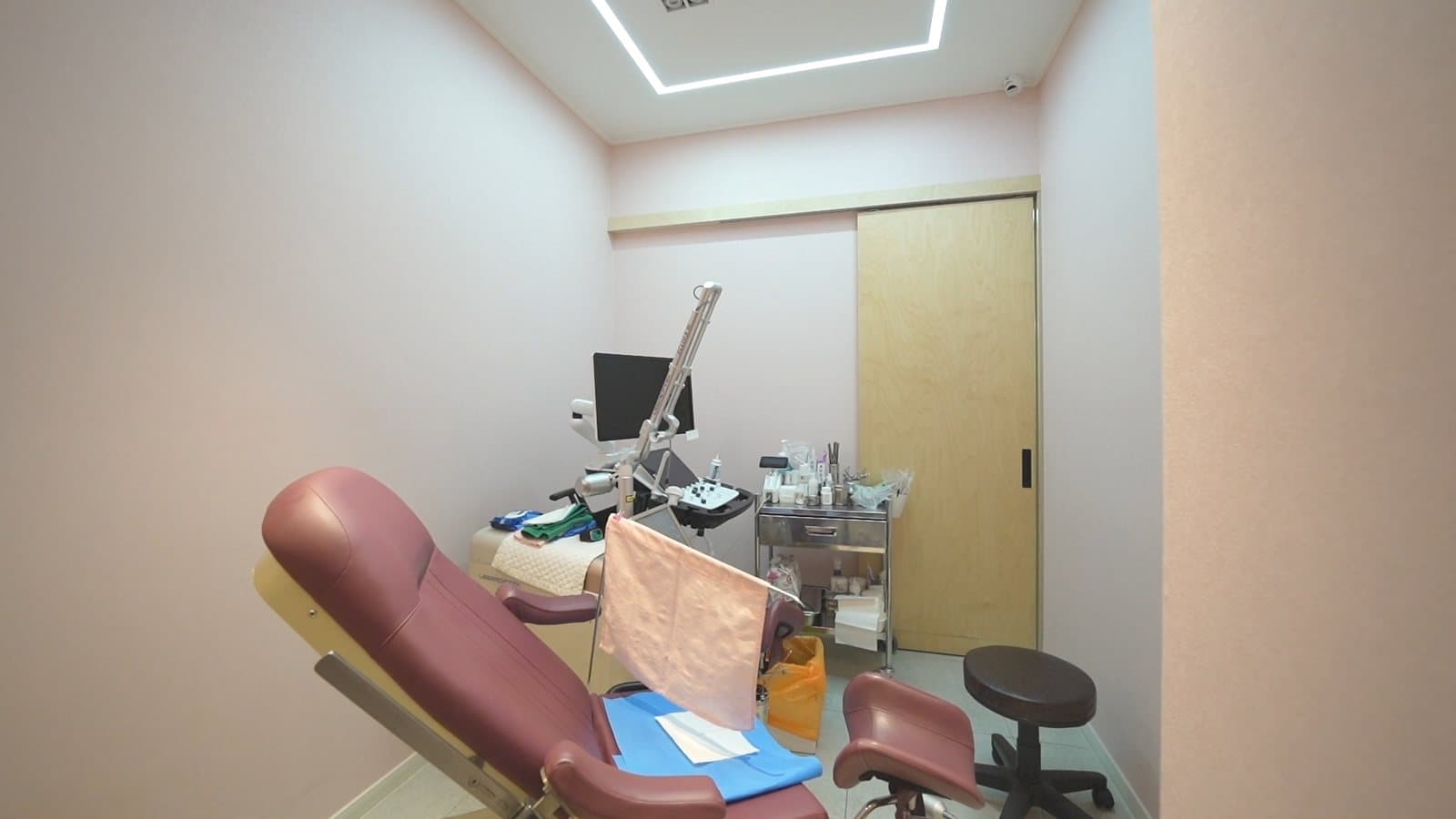
A transvaginal scan should not hurt. Pressure, a sense of fullness, and a moment of discomfort when the probe angles towards an ovary are all ordinary. Sharp pain is not, and it is information rather than something to endure quietly — it can mean the angle needs changing, or that there is something tender there worth knowing about.
The speculum, the smear and the swabs
A speculum is the instrument that holds the walls apart so the cervix can be seen. It is used when something has to be collected or looked at directly — a cervical smear, swabs for infection, or checking a visible symptom. It is not used for an ordinary ultrasound.
- It is cold unless it has been warmed, and asking for a warmed one is a normal thing to ask.
- It comes in sizes. If a previous exam hurt, saying so means a smaller one is used — this is routine, not a special accommodation.
- The sensation is pressure and opening, not sharpness. It lasts under a minute for a smear.
- The sample itself takes seconds — a soft brush against the cervix. Some people feel nothing; some feel a brief cramp like a period pain.
Light spotting for a day afterwards is common and not a problem. Heavy bleeding or pain afterwards is not expected, and is worth a call.
If a biopsy is needed — a small piece of tissue rather than a brush of cells — that is a different and usually brief procedure, with a cramping sensation for a few seconds. It is explained before it happens, and it is one you can ask to postpone to another appointment if you would rather come back prepared. Cervical screening and abnormal results go into what the samples are actually for.
You can stop it
This is the part that is almost never said plainly, so here it is plainly: you can decline any examination, and you can stop one that has already started. Not as a confrontation and not as a special case. Saying "stop" or "wait" is enough, and it ends there.
- You do not have to give a reason. "I'd rather not today" is a complete sentence.
- Changing your mind is not wasting anyone's time. Half of a plan is better than none, and the other half can be another day.
- You can ask for the steps to be narrated — what is about to happen, just before it happens. Many people find this removes most of the fear by itself.
- You can ask for a companion or a second staff member in the room.
- You can ask to insert a tampon-sized probe yourself where that is offered, which some people prefer.
If an examination has been difficult or frightening before, saying that at the start changes the whole appointment. It is heard often, it is not unusual, and the options — a smaller instrument, a different route, more explanation, or doing it another day — are all ordinary ones that nobody has to argue for.
Small practical things
- Being on your period is usually fine for a consultation, an ultrasound and most swabs. A cervical smear is the one commonly rescheduled, so it is worth mentioning when you book.
- You do not need to remove hair or do anything in advance. Nobody notices and nobody is looking for it.
- A normal shower is enough. Do not use an intimate wash or douche beforehand — it can disturb the very samples being taken.
- Wear something you are comfortable half-dressed in. A skirt or dress means less undressing than trousers, which some people prefer.
- Bring the date of your last period if you know it, and a list of anything you take.
On privacy, which is the other unspoken question: what you say is part of your medical record and is not shared with family, a partner or an employer. Sexual history is asked because it changes which tests make sense, not for any other reason — and a different answer does not change the quality of the care.
Common questions
I have never had sex. Do I have to have an internal ultrasound?
No. An abdominal or rectal scan is used instead, and you only have to say so — no explanation is needed and nothing about your care changes. It is asked routinely for exactly this reason: it decides which route is used, nothing else.
Does it hurt?
It should not. Pressure, fullness and brief discomfort are ordinary; sharp pain is not, and it means something should change — the angle, a smaller instrument, or more time. Say so as it happens rather than afterwards. If an earlier exam hurt, mentioning that at the start usually prevents a repeat.
Can I go while I am on my period?
Yes for a consultation, an ultrasound and most swabs. A cervical smear is usually rescheduled because blood interferes with the sample, so mention it when booking and the appointment can be placed accordingly. Bleeding that is itself the reason for the visit is never a reason to wait.
If I refuse an examination, will I still be treated?
Yes. Declining one part does not end the appointment. You may be told what cannot be answered without it, which is information rather than pressure, and you can decide to come back for that part another day. Consent is for each step, not for the whole visit at the door.
Will anyone find out I came?
Your record is yours. It is not shared with family, a partner or an employer, and what you say in the room stays in the room. If you have a specific concern — a shared phone, a family insurance plan, a message that must not arrive — say it at the desk and the practical details can be arranged around it.
Talk to someone, privately
Ium in Seocho supports international women with confidential, English-speaking care. Reach out with a message or a call — no pressure, no judgment.
Book a private consultationThis article is general information, not medical advice, and does not replace a consultation with a licensed doctor. Details of care and current guidance should be confirmed directly with the clinic.